"MVP" is probably the most misused term in product development. Some people use it to mean "a cheap first version", others "everything we want, but rushed". Both lead to the same place: a product that took too long, cost too much and still did not answer the question that mattered.
What an MVP actually is
An MVP (minimum viable product) is the smallest version of your product that real users can use to solve a real problem, built to learn whether the idea works before investing in everything else.
Two words carry the weight:
- Minimum: only what is needed to complete the core job. Nothing "for later".
- Viable: it has to work well. A broken or confusing product teaches you nothing, because people abandon it before you learn anything.
What an MVP is not
- It is not a prototype. A prototype simulates the product; an MVP is used for real, with real data and, ideally, real money.
- It is not version 1.0 with fewer screens. It is a version focused on one hypothesis.
- It is not ugly on purpose. Good design costs little when the scope is small, and it changes whether people trust the product.
Start with the riskiest question
Every product idea rests on assumptions. Write them down and pick the one that would kill the business if it were false. Usually it is one of these:
- Do people have this problem badly enough to change how they solve it?
- Will they pay for it, and how much?
- Can we deliver the promise (supply, operations, technology)?
The MVP exists to answer that question. Every feature that does not help answer it waits.
A method to decide what goes in
1. Write the core flow in one sentence
"An attendee scans a QR, orders, pays and picks up without waiting in line." That sentence is the MVP. If a feature is not part of it, it is a candidate to cut.
2. List everything, then sort into three columns
- Must have: without it the core flow does not work.
- Should have: improves the experience, but users can complete the job without it.
- Later: everything else, especially what starts with "it would be nice if".
Only the first column gets built. Be ruthless: most teams put twice as many things in "must" as they should.
3. Do manually what you can
Reports, approvals, onboarding and support can be done by a person with a simple admin panel at first. Automate when the volume hurts, not before.
4. Define what success looks like before launching
Pick two or three numbers that will tell you whether the hypothesis holds: how many users complete the core flow, how many come back, how many pay. Without that, the launch is just an opinion.
Examples from our work
The core of Nubapay fits in one sentence: order and pay from your phone at an event, and pick up with a unique QR. Everything else, from the live dashboard for organizers to the AI assistant, exists to support that flow. If a feature does not make that sentence work better, it is not part of the core.
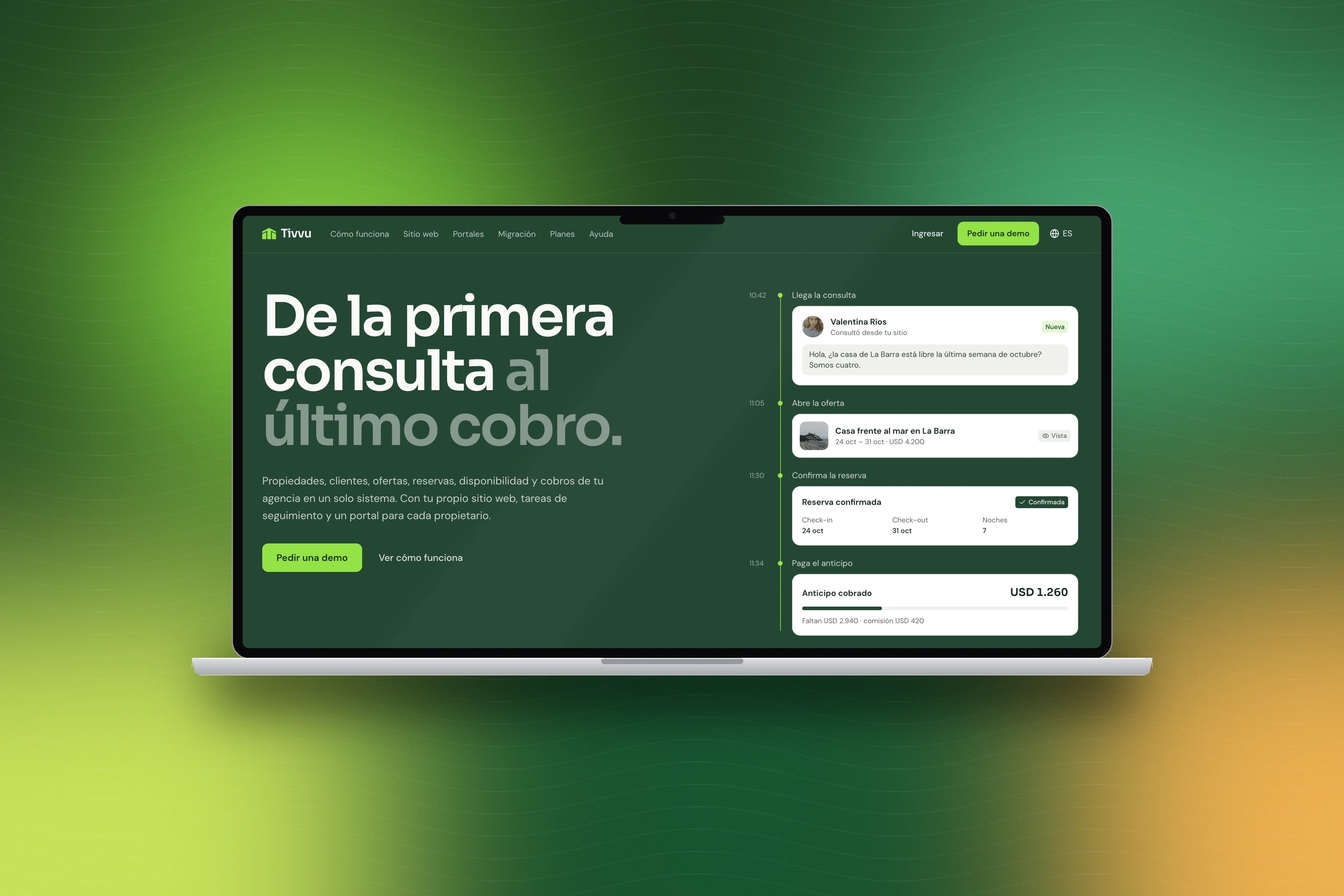
Tivvu gives real estate agencies one place for listings, clients and offers. The data importer looks like a secondary feature, but it is part of the core: an agency will not adopt a new system if moving over means retyping hundreds of properties. Sometimes the "must have" is what removes the reason not to switch.
How long it takes and what it costs
A well-defined MVP usually takes two to four months. The investment depends entirely on the product: the roles, payments and integrations in that first flow. We explain what defines it in how much it costs to build an app.
After the MVP
Launching is where learning starts. Measure, talk to users, and decide what to build next based on what they do, not what they say. The "later" column will look very different after a month with real users.
If you are trying to define the MVP for your idea, we can help you scope it. Most of the value of a good MVP is decided before anyone writes code.
Frequently asked questions
How long does it take to build an MVP?
A focused MVP for a web or mobile product usually takes two to four months, depending on the number of user roles, payments and integrations.
What is the difference between an MVP and a prototype?
A prototype simulates the product to test ideas and usability. An MVP is a working product that real users use with real data, so you can measure actual behavior.
How many features should an MVP have?
As few as needed to complete one core flow for one type of user. If you cannot describe the MVP in a single sentence, it probably has too much.